Just FYI: This whole page is better suited for desktop ;)
Sebrae
Summary
Sebrae Financial Planner is a free financial management platform that helps Brazilian small businesses plan, track, and make more informed decisions about their finances.
I joined the project to work on the evolution of the platform experience, designing new features and rethinking key areas of the product, particularly the Home, Monitoring, Consulting, and Follow-up experiences.
My role covered end-to-end Product Design, from problem exploration and co-creation with stakeholders to flows, prototypes, interfaces, and implementation support.
The Challenge
The Financial Planner was already a robust product, with multiple journeys, user profiles, and a significant amount of business logic.
Our challenge wasn’t to rebuild it. It was to understand how we could evolve it in ways that would genuinely be useful to the people using it every day.
Business owners, consultants, and Sebrae specialists interact with the platform in very different ways. Every new feature had to support these contexts without adding even more complexity to the experience.
Rather than simply designing new screens, we wanted product evolution to start with real problems and to build solutions together with the people who understood those problems best.
Designing with the people who know the product
One of the most important aspects of the project was how we worked.
For every major initiative, we ran three to four-day Design Sprints with Sebrae specialists and other stakeholders who used or closely supported the Financial Planner.
During these sessions, we explored the problem, brought different perspectives into the conversation, investigated possible solutions, and built the first concepts together.
Understand → Explore → Co-create → Prototype → Gather feedback → Refine
This allowed us to go beyond simply receiving a set of requirements.
We combined Sebrae’s business expertise, the practical experience of people using the platform, and our team’s product and design perspective.
It created a much more collaborative process, allowing us to validate decisions while we were still making them and build solutions that were much more closely connected to real user needs.
Rethinking the Home
One of the main initiatives I worked on was the new Financial Planner Home.
With multiple tools, features, and possible stages within the platform, we realized the homepage needed to do more than provide navigation.
It needed to answer a simple question:
What should I do next?
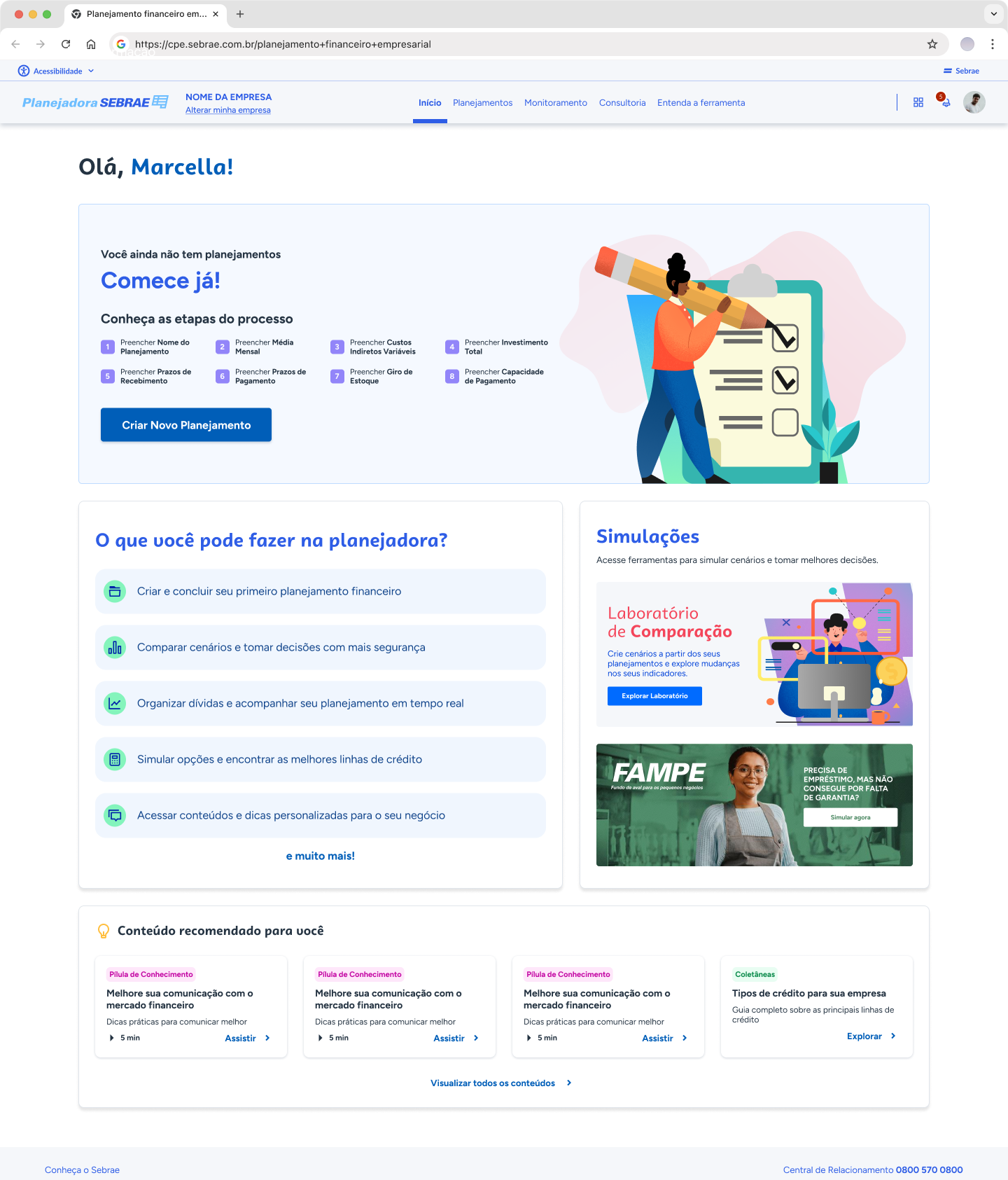
We transformed the Home into a central orientation point for the entire journey.
Its main content dynamically adapts to the user’s most relevant current state, showing, for example, whether they haven’t started a plan yet, have something in progress, completed a stage, or need to update an ongoing monitoring cycle.
Instead of giving every piece of information the same priority, we created a hierarchy that helps users understand their context and identify their next action.
The Home also brings together access to key features, simulation tools, and recommended content, turning it into a true starting point for the overall experience.


Expanding the journey
We applied the same collaborative approach to other initiatives across the Financial Planner.
From planning to reality
One of the most valuable areas of the product for business owners is Monitoring.
A financial plan represents an intention. Monitoring shows what is actually happening.
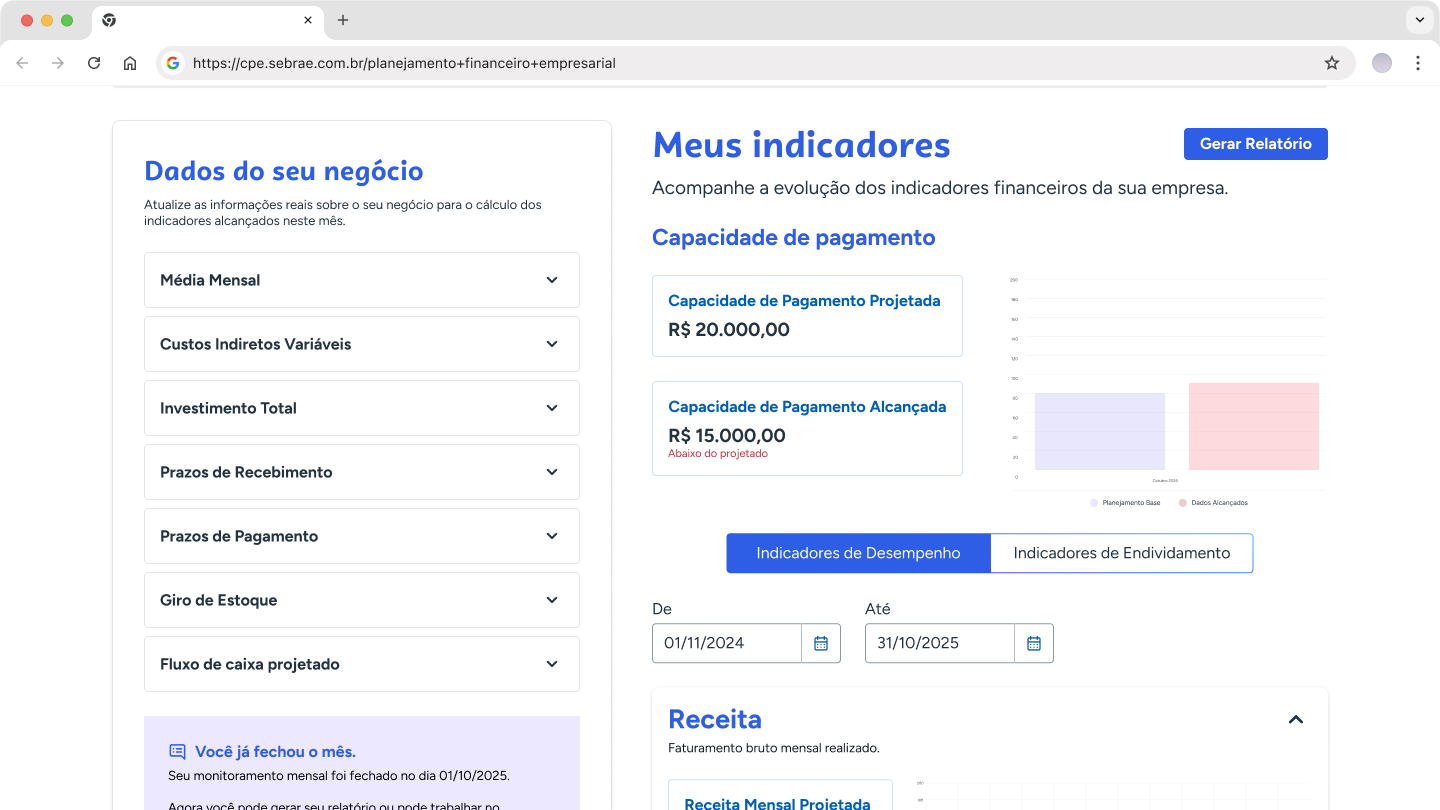
The experience allows a completed plan to become the baseline for periodically tracking the company’s real financial performance.
As business owners update their financial data, they can review current indicators and compare what they originally planned with what is actually happening in the business.
Our challenge was to make the transition from planning to tracking feel like a natural continuation of the journey, despite the different states, entry points, and business rules behind the experience.
More than simply recording new numbers, Monitoring helps business owners understand whether the company is moving in the expected direction, identify changes over time, and recognize when certain indicators require attention.
It turns a financial plan from a static snapshot into an ongoing management tool.
Our challenge was to make the transition from planning to tracking feel like a natural continuation of the journey, despite the different states, entry points, and business rules behind the experience.
More than simply recording new numbers, Monitoring helps business owners understand whether the company is moving in the expected direction, identify changes over time, and recognize when certain indicators require attention.
It turns a financial plan from a static snapshot into an ongoing management tool.
Exploring the future with the Scenario Lab
If Monitoring helps users understand where their business is today, the Scenario Lab helps them explore where it could go next.
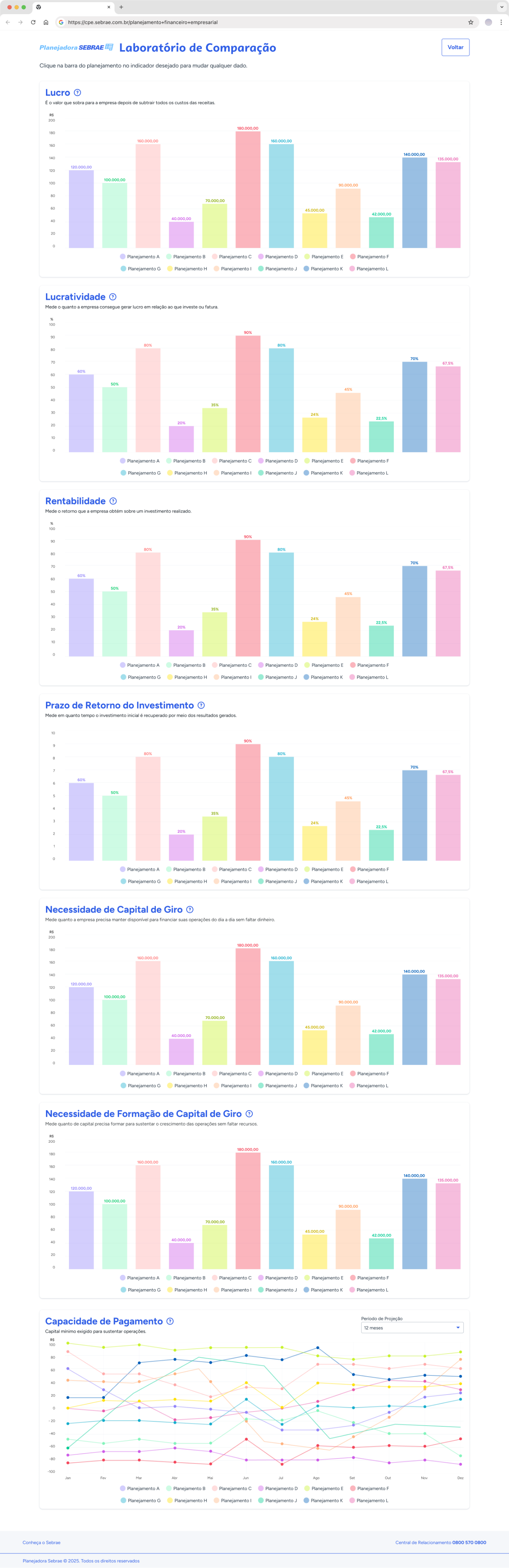
The Scenario Comparison Lab was designed as a space where business owners can test hypotheses and compare different financial possibilities before making a decision.
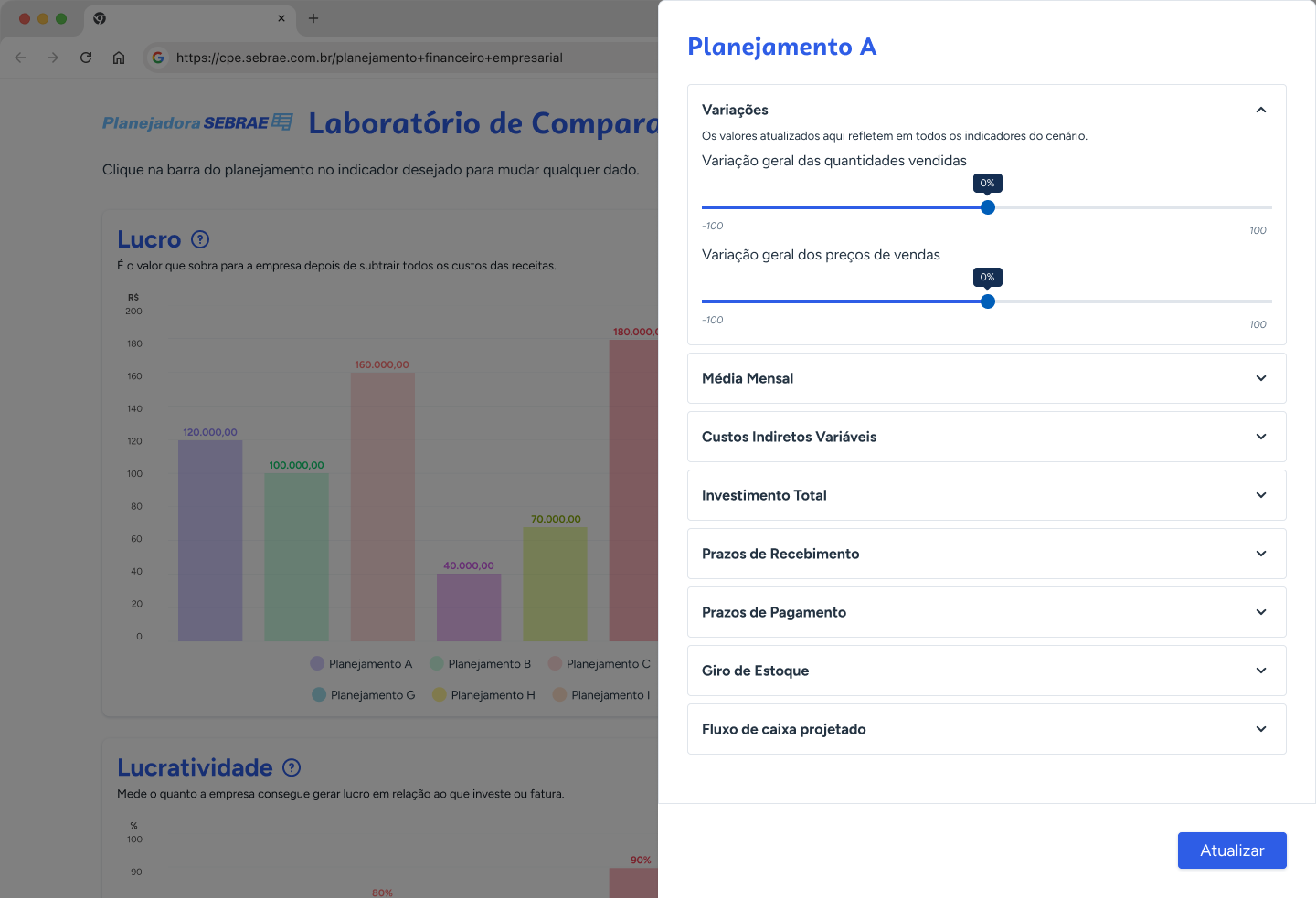
Users can take existing plans and treat them as independent scenarios, comparing them side by side to understand how different choices could affect key business indicators.
Most importantly, these simulations do not change the original plans.
That creates a safe space for experimentation.
A business owner can explore, for example, how changes in revenue, costs, investments, or financial structure could affect company performance and compare those possibilities before deciding which direction makes the most sense.
We implemented this experience because financial planning is not only about understanding current numbers.
It is also about being able to ask:

What happens if I make this decision?
Which scenario looks more sustainable?
How could this change affect my business?
With the Scenario Lab, the Financial Planner supports not only financial tracking, but also the thinking behind financial decisions.
Monitoring and the Lab ultimately provide two complementary perspectives:
Monitoring → understand the current reality
Scenario Lab → explore future possibilities
Together, they expand the value of the platform by turning financial information into context for real business decisions.
A continuous product process
Although each initiative solved a different problem, our way of working remained consistent.
We started with Design Sprints, developing a shared understanding of the problem with the people involved. From there, we translated those insights into journeys, flows, and prototypes, refining the solutions alongside Product, Engineering, and Sebrae stakeholders.
Feedback didn’t happen only at the end.
It was part of the entire process.
That proximity was particularly important for a complex product like the Financial Planner because it allowed us to balance user needs, business rules, and technical feasibility from the beginning of each initiative.
Impact
Today, the Financial Planner has reached around 70,000 users, supporting small businesses across Brazil as they manage and track their financial health.
But the impact of the work goes beyond the platform’s reach.
The initiatives we designed expanded the role of the Financial Planner throughout the business owner’s journey.
The Home helps users identify their next step.
Monitoring gives them visibility into the real state of their business.
The Scenario Lab helps them explore future possibilities.
Consulting and Follow-up connect business owners with specialists throughout that process.


Resume
Back
Sebrae
Summary
Sebrae Financial Planner is a free financial management platform that helps Brazilian small businesses plan, track, and make more informed decisions about their finances.
I joined the project to work on the evolution of the platform experience, designing new features and rethinking key areas of the product, particularly the Home, Monitoring, Consulting, and Follow-up experiences.
My role covered end-to-end Product Design, from problem exploration and co-creation with stakeholders to flows, prototypes, interfaces, and implementation support.
The Challenge
The Financial Planner was already a robust product, with multiple journeys, user profiles, and a significant amount of business logic.
Our challenge wasn’t to rebuild it. It was to understand how we could evolve it in ways that would genuinely be useful to the people using it every day.
Business owners, consultants, and Sebrae specialists interact with the platform in very different ways. Every new feature had to support these contexts without adding even more complexity to the experience.
Rather than simply designing new screens, we wanted product evolution to start with real problems and to build solutions together with the people who understood those problems best.
Designing with the people who know the product
One of the most important aspects of the project was how we worked.
For every major initiative, we ran three to four-day Design Sprints with Sebrae specialists and other stakeholders who used or closely supported the Financial Planner.
During these sessions, we explored the problem, brought different perspectives into the conversation, investigated possible solutions, and built the first concepts together.
Understand → Explore → Co-create → Prototype → Gather feedback → Refine
This allowed us to go beyond simply receiving a set of requirements.
We combined Sebrae’s business expertise, the practical experience of people using the platform, and our team’s product and design perspective.
It created a much more collaborative process, allowing us to validate decisions while we were still making them and build solutions that were much more closely connected to real user needs.
Rethinking the Home
One of the main initiatives I worked on was the new Financial Planner Home.
With multiple tools, features, and possible stages within the platform, we realized the homepage needed to do more than provide navigation.
It needed to answer a simple question:
What should I do next?
We transformed the Home into a central orientation point for the entire journey.
Its main content dynamically adapts to the user’s most relevant current state, showing, for example, whether they haven’t started a plan yet, have something in progress, completed a stage, or need to update an ongoing monitoring cycle.
Instead of giving every piece of information the same priority, we created a hierarchy that helps users understand their context and identify their next action.
The Home also brings together access to key features, simulation tools, and recommended content, turning it into a true starting point for the overall experience.
Expanding the journey
We applied the same collaborative approach to other initiatives across the Financial Planner.
From planning to reality
One of the most valuable areas of the product for business owners is Monitoring.
A financial plan represents an intention. Monitoring shows what is actually happening.
The experience allows a completed plan to become the baseline for periodically tracking the company’s real financial performance.
As business owners update their financial data, they can review current indicators and compare what they originally planned with what is actually happening in the business.
Our challenge was to make the transition from planning to tracking feel like a natural continuation of the journey, despite the different states, entry points, and business rules behind the experience.
More than simply recording new numbers, Monitoring helps business owners understand whether the company is moving in the expected direction, identify changes over time, and recognize when certain indicators require attention.
It turns a financial plan from a static snapshot into an ongoing management tool.
Our challenge was to make the transition from planning to tracking feel like a natural continuation of the journey, despite the different states, entry points, and business rules behind the experience.
More than simply recording new numbers, Monitoring helps business owners understand whether the company is moving in the expected direction, identify changes over time, and recognize when certain indicators require attention.
It turns a financial plan from a static snapshot into an ongoing management tool.
Exploring the future with the Scenario Lab
If Monitoring helps users understand where their business is today, the Scenario Lab helps them explore where it could go next.
The Scenario Comparison Lab was designed as a space where business owners can test hypotheses and compare different financial possibilities before making a decision.
Users can take existing plans and treat them as independent scenarios, comparing them side by side to understand how different choices could affect key business indicators.
Most importantly, these simulations do not change the original plans.
That creates a safe space for experimentation.
A business owner can explore, for example, how changes in revenue, costs, investments, or financial structure could affect company performance and compare those possibilities before deciding which direction makes the most sense.
We implemented this experience because financial planning is not only about understanding current numbers.
It is also about being able to ask:
What happens if I make this decision?
Which scenario looks more sustainable?
How could this change affect my business?
With the Scenario Lab, the Financial Planner supports not only financial tracking, but also the thinking behind financial decisions.
Monitoring and the Lab ultimately provide two complementary perspectives:
Monitoring → understand the current reality
Scenario Lab → explore future possibilities
Together, they expand the value of the platform by turning financial information into context for real business decisions.
A continuous product process
Although each initiative solved a different problem, our way of working remained consistent.
We started with Design Sprints, developing a shared understanding of the problem with the people involved. From there, we translated those insights into journeys, flows, and prototypes, refining the solutions alongside Product, Engineering, and Sebrae stakeholders.
Feedback didn’t happen only at the end.
It was part of the entire process.
That proximity was particularly important for a complex product like the Financial Planner because it allowed us to balance user needs, business rules, and technical feasibility from the beginning of each initiative.
Impact
Today, the Financial Planner has reached around 70,000 users, supporting small businesses across Brazil as they manage and track their financial health.
But the impact of the work goes beyond the platform’s reach.
The initiatives we designed expanded the role of the Financial Planner throughout the business owner’s journey.
The Home helps users identify their next step.
Monitoring gives them visibility into the real state of their business.
The Scenario Lab helps them explore future possibilities.
Consulting and Follow-up connect business owners with specialists throughout that process.


✦
Resume
Back
Sebrae
Summary
Sebrae Financial Planner is a free financial management platform that helps Brazilian small businesses plan, track, and make more informed decisions about their finances.
I joined the project to work on the evolution of the platform experience, designing new features and rethinking key areas of the product, particularly the Home, Monitoring, Consulting, and Follow-up experiences.
My role covered end-to-end Product Design, from problem exploration and co-creation with stakeholders to flows, prototypes, interfaces, and implementation support.
The Challenge
The Financial Planner was already a robust product, with multiple journeys, user profiles, and a significant amount of business logic.
Our challenge wasn’t to rebuild it. It was to understand how we could evolve it in ways that would genuinely be useful to the people using it every day.
Business owners, consultants, and Sebrae specialists interact with the platform in very different ways. Every new feature had to support these contexts without adding even more complexity to the experience.
Rather than simply designing new screens, we wanted product evolution to start with real problems and to build solutions together with the people who understood those problems best.
Designing with the people who know the product
One of the most important aspects of the project was how we worked.
For every major initiative, we ran three to four-day Design Sprints with Sebrae specialists and other stakeholders who used or closely supported the Financial Planner.
During these sessions, we explored the problem, brought different perspectives into the conversation, investigated possible solutions, and built the first concepts together.
Understand → Explore → Co-create → Prototype → Gather feedback → Refine
This allowed us to go beyond simply receiving a set of requirements.
We combined Sebrae’s business expertise, the practical experience of people using the platform, and our team’s product and design perspective.
It created a much more collaborative process, allowing us to validate decisions while we were still making them and build solutions that were much more closely connected to real user needs.
Rethinking the Home
One of the main initiatives I worked on was the new Financial Planner Home.
With multiple tools, features, and possible stages within the platform, we realized the homepage needed to do more than provide navigation.
It needed to answer a simple question:
What should I do next?
We transformed the Home into a central orientation point for the entire journey.
Its main content dynamically adapts to the user’s most relevant current state, showing, for example, whether they haven’t started a plan yet, have something in progress, completed a stage, or need to update an ongoing monitoring cycle.
Instead of giving every piece of information the same priority, we created a hierarchy that helps users understand their context and identify their next action.
The Home also brings together access to key features, simulation tools, and recommended content, turning it into a true starting point for the overall experience.


Expanding the journey
We applied the same collaborative approach to other initiatives across the Financial Planner.
From planning to reality
One of the most valuable areas of the product for business owners is Monitoring.
A financial plan represents an intention. Monitoring shows what is actually happening.
The experience allows a completed plan to become the baseline for periodically tracking the company’s real financial performance.
As business owners update their financial data, they can review current indicators and compare what they originally planned with what is actually happening in the business.
Our challenge was to make the transition from planning to tracking feel like a natural continuation of the journey, despite the different states, entry points, and business rules behind the experience.
More than simply recording new numbers, Monitoring helps business owners understand whether the company is moving in the expected direction, identify changes over time, and recognize when certain indicators require attention.
It turns a financial plan from a static snapshot into an ongoing management tool.
Exploring the future with the Scenario Lab
If Monitoring helps users understand where their business is today, the Scenario Lab helps them explore where it could go next.
The Scenario Comparison Lab was designed as a space where business owners can test hypotheses and compare different financial possibilities before making a decision.
Users can take existing plans and treat them as independent scenarios, comparing them side by side to understand how different choices could affect key business indicators.
Most importantly, these simulations do not change the original plans.
That creates a safe space for experimentation.
A business owner can explore, for example, how changes in revenue, costs, investments, or financial structure could affect company performance and compare those possibilities before deciding which direction makes the most sense.
We implemented this experience because financial planning is not only about understanding current numbers.
It is also about being able to ask:
What happens if I make this decision?
Which scenario looks more sustainable?
How could this change affect my business?
With the Scenario Lab, the Financial Planner supports not only financial tracking, but also the thinking behind financial decisions.
Monitoring and the Lab ultimately provide two complementary perspectives:
Monitoring → understand the current reality
Scenario Lab → explore future possibilities
Together, they expand the value of the platform by turning financial information into context for real business decisions.
A continuous product process
Although each initiative solved a different problem, our way of working remained consistent.
We started with Design Sprints, developing a shared understanding of the problem with the people involved. From there, we translated those insights into journeys, flows, and prototypes, refining the solutions alongside Product, Engineering, and Sebrae stakeholders.
Feedback didn’t happen only at the end.
It was part of the entire process.
That proximity was particularly important for a complex product like the Financial Planner because it allowed us to balance user needs, business rules, and technical feasibility from the beginning of each initiative.
Impact
Today, the Financial Planner has reached around 70,000 users, supporting small businesses across Brazil as they manage and track their financial health.
But the impact of the work goes beyond the platform’s reach.
The initiatives we designed expanded the role of the Financial Planner throughout the business owner’s journey.
The Home helps users identify their next step.
Monitoring gives them visibility into the real state of their business.
The Scenario Lab helps them explore future possibilities.
Consulting and Follow-up connect business owners with specialists throughout that process.